Coaling in the Pinelands
- khilton
- May 15
- 7 min read

Kirby's Mill, built 1778, Church and Fostertown Roads, Medford, was the last commercial operating mill in New Jersey. Another Pinelands treasure.
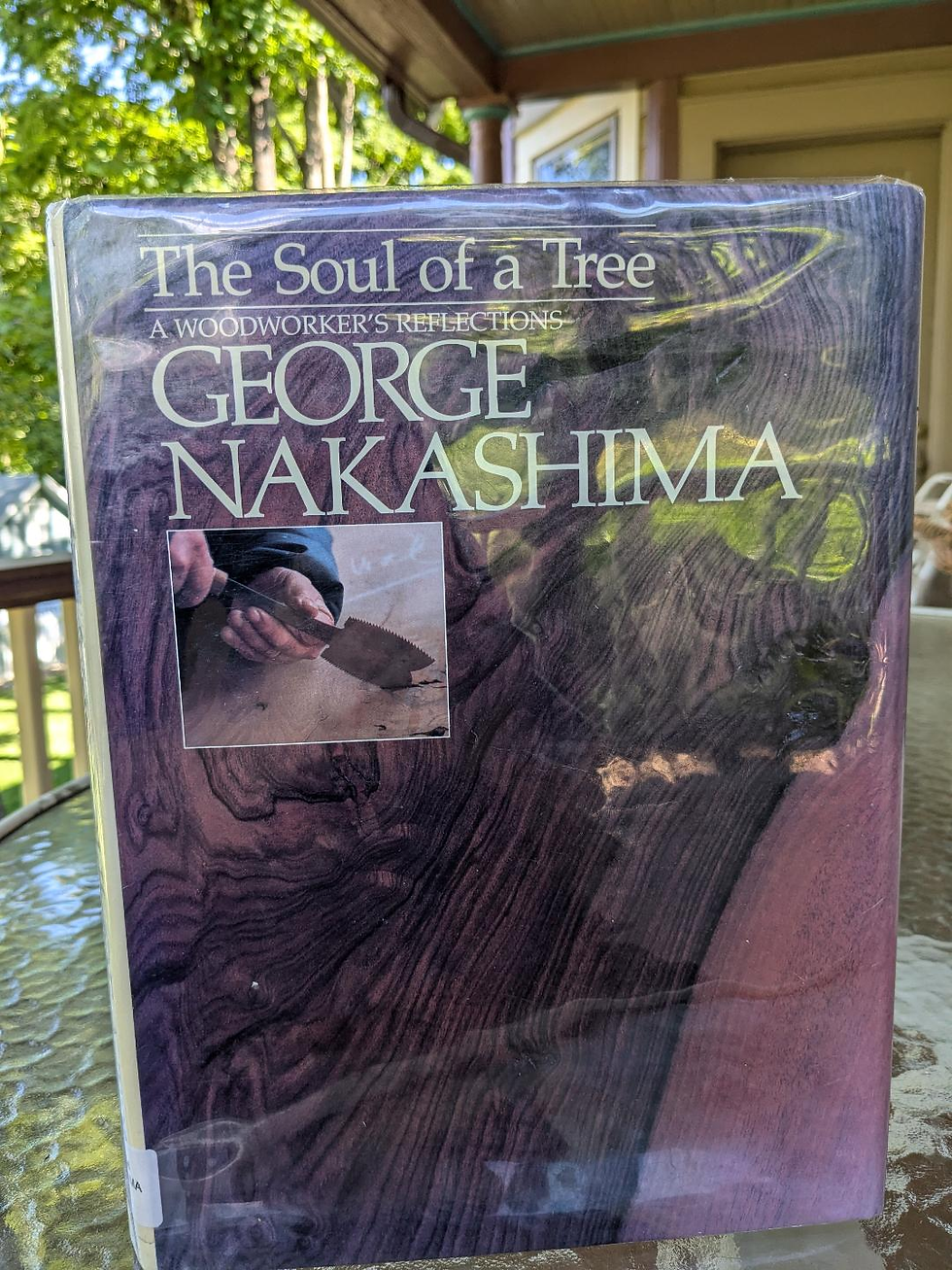
Applied Botany offered the essay, Cooking Conifers, in January 2025. It included historic uses for pine tar and the example given was the manner in which the Vikings made pine tar resin for waterproofing their ships and, eventually, the ancient stave churches which, to this day, exhale a piney fragrance. At that time, I didn't know I would enjoy a reunion with a family friend later that year, Ted Gordon. As a Pinelands authority, he was the author of an article on charcoal making entitled, "Herbert Payne: Last of the Old-Time Charcoal Makers and His Coaling Process in the Pine Barrens of New Jersey". This story is a summary taken from Ted's scholarly work and I'm quoting liberally from his text which left me smitten with Mr. Payne, as well as with the author, Herr Gordon, the high school German teacher and esteemed mentor of our sister*. His interest in the Pinelands and the production of charcoal reaches back to 1959. This essay doesn't do justice to the making of charcoal in the old-fashioned "coaling" method now extinct in the New Jersey Pinelands. Today, people might make charcoal in a greatly revised manner in small batches, but not in the large amount as had been done over many years.
Ted Gordon is a Pine Barrens botanist, historian, and photographer and his celebrated article not only serves to explain in detail the how's of charcoal making, but also to chronicle and honor the last Pineland Collier (charcoal maker), Herbert Payne. As a postscript to his article, Mr. Gordon expressed his appreciation to Herbert Payne for many pleasant hours shared discussing the intricacies of charcoal making. "Few men, if any, were more knowledgeable on this subject than Mr. Payne." Mr. Gordon spent two weeks during the summer of 1974 with Mr. Payne to learn and obtain photographic documentation of what would be Mr. Payne's final open-pit coaling. All photos except for Kirby's Mill and the Collier's shack were taken by Ted Gordon.
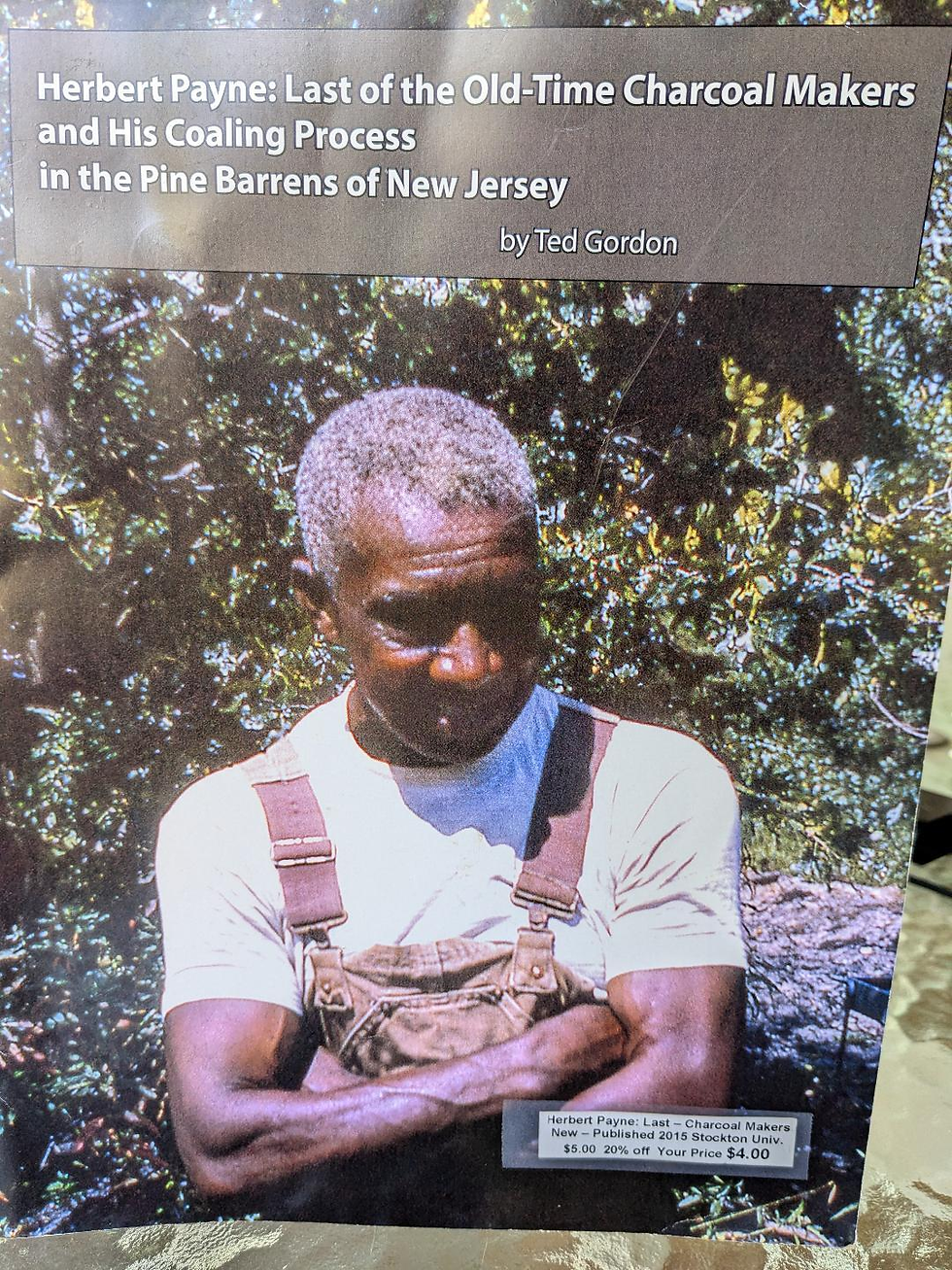
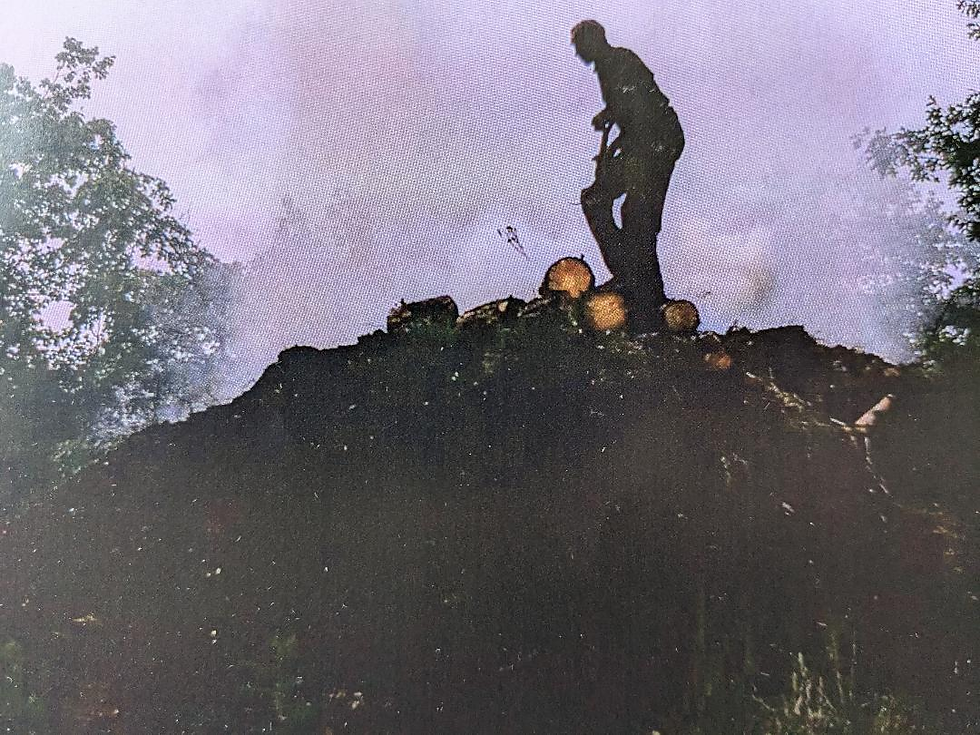
Readers of Applied Botany, who are known to have big hearts, will embrace the humble bearing of Mr. Payne in this photo. It touches me deeply. I wish I had met him.
I hadn't realized during writing of the recent peat article that I was digging my way toward coal. To tell the story of Herbert Payne, we should first go into the world of carbon and because it is related to charcoal, you might benefit from a brief primer on all of it.
Coal originates from the remains of plants, including trees, ferns and other
vegetation that accumulated in swampy environments. This organic matter is rich in carbon and undergoes significant transformation over millions of years. Initially, when plant material dies, it accumulates in waterlogged conditions, forming peat. This environment is low in oxygen, which slows down the decomposition process and allows the organic material to accumulate. Over time, layers of sediment bury the peat, subjecting it to increased pressure and temperature. This process, known as coalification, leads to the chemical and physical changes that convert peat into coal. As the peat is buried deeper, volatile compounds are expelled, and the carbon content increases, resulting in different ranks of coal, such as lignite, bituminous and anthracite.
Charcoal was made mainly from oaks and pitch pines found abundantly in Southern NJ. It is wood from which water, volatile gases, tars and resins have been burnt off, above 750 degrees, in an oxygen-starved environment leaving pure carbon. It was made by this same ancient process as long ago as 370 BC. So great was the demand for charcoal in the 18th and 19th centuries that large tracts of woodland were denuded of trees. Thus, most forests in the Pine Barrens today are second or third growth.
Charcoal will burn at a higher temperature than wood and is commonly used for cooking and grilling, whereas coke, derived from coal through a process called coking, is primarily used in industrial processes, especially in steel production. Charcoal is considered a renewable resource, while coal is not. Trees can be grown; coal in the planet is finite. Charcoal has a higher carbon content (about 98%) compared to coke, which contains impurities from coal.
With this story, the risk of losing you is likely if every step were explained in the construction of the charcoal kiln and in making charcoal. Asking your forgiveness, we will stick to showing photos with captions, admitting up front that many of the vital details are omitted and you would not be prepared to become a collier and make charcoal from following this story.
Below see a partially set charcoal kiln (a cone pile) using 8-foot railroad ties. While earlier European charcoal production was done in pits below the ground, the traditional American kiln was completely above ground. Soldiers in Vietnam observed people making charcoal using a true pit-method. Almost any kind of wood could be burned into charcoal.
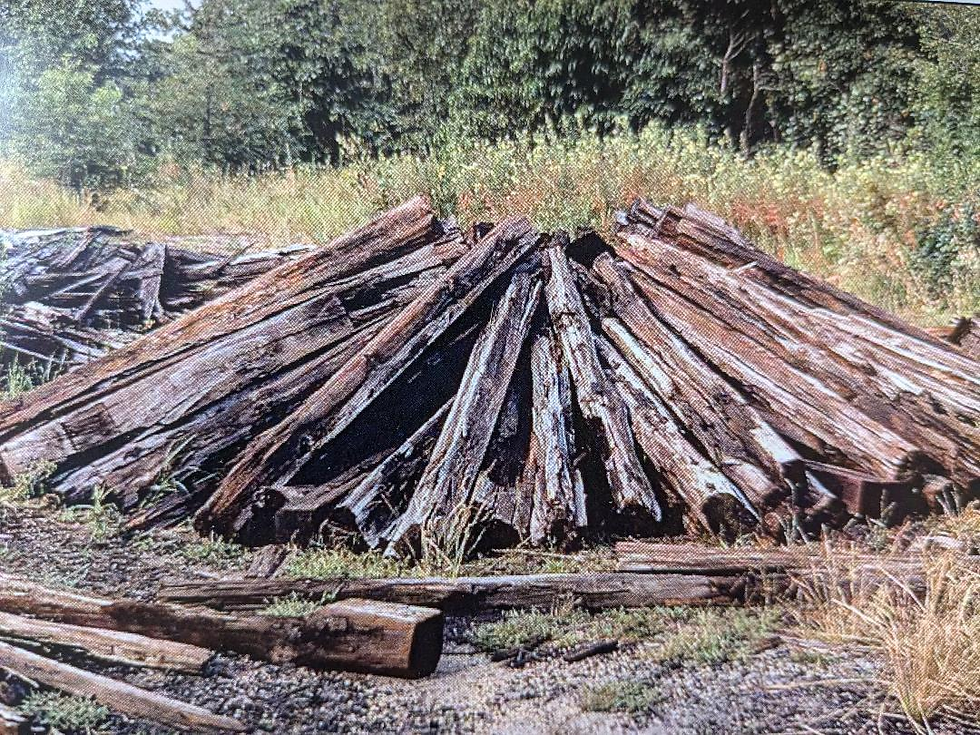
There is a two-foot square central chimney space allowed in each kiln. Air pockets have to be sealed to insure uniform burning. Mr. Gordon wrote about "dressing out" the chimney which means the chimney was packed with kindling including "fat pine" (high resin pine) and is what would be set alight.
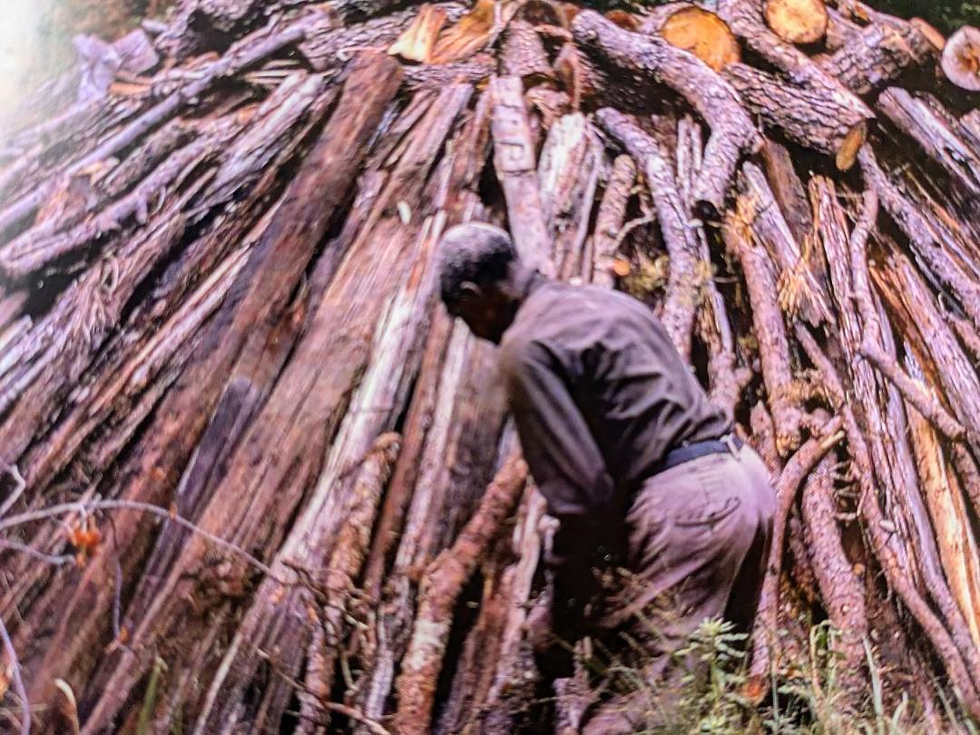
There was a final application of smaller pieces of "lap wood" over the medium logs or railroad ties to fill in and make the kiln's surface relatively even and airtight. Refuse wood of variable shape and size was used. After the kiln is lapped off, moist patches of turf, called "floats" are applied, tightly packed and covering the entire kiln. The mats of turf were cut from the edge of a cedar swamp and a high percentage of the vegetation comprising the turf was sheep laurel, black huckleberry and teaberry.
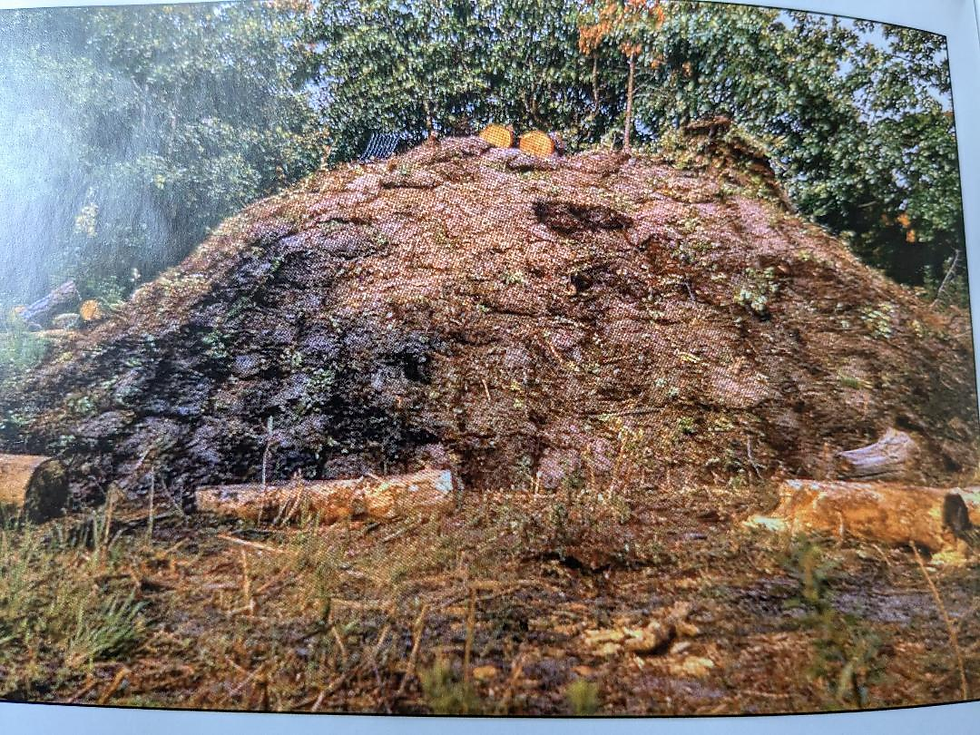
On top of the turf the collier applied a 4- to 5- inch layer of sand to ensure that it was totally airtight. To allow for sufficient draft and to permit smoke and gases to escape, flue holes about two feet apart were poked all around the pit. The draft needed to be adjusted carefully. Too much draft would cause the pit to burst into flames and consume the pile. Too little draft and the fire inside the pit would go out. Opening or decreasing the size of the flue holes was a risky process that required the collier to climb up onto the intensely hot kiln.
Finally, it was time to "fire the kiln". Gasoline or kerosene was poured down the central opening and lit - or - a long pole wrapped on one end with lighted kerosene rags and pushed far into the chimney started the fire. The top opening was closed with chunks of pinewood, covered with turf and then sand.

After 10-14 days of burning or carbonization, flue holes were closed and the top of the pile was raked off, releasing the sand to work its way through the charcoal to the bottom and in the process extinguish the remaining fire. The charcoal was ready to be drawn out, but with caution. A proper amount of time has to pass so that the kiln could cool. Because of the immense heat in the kiln, charcoal drawn out too early could burst into flames when contacting the air. Water in large drums had to kept at hand in case of such fire.
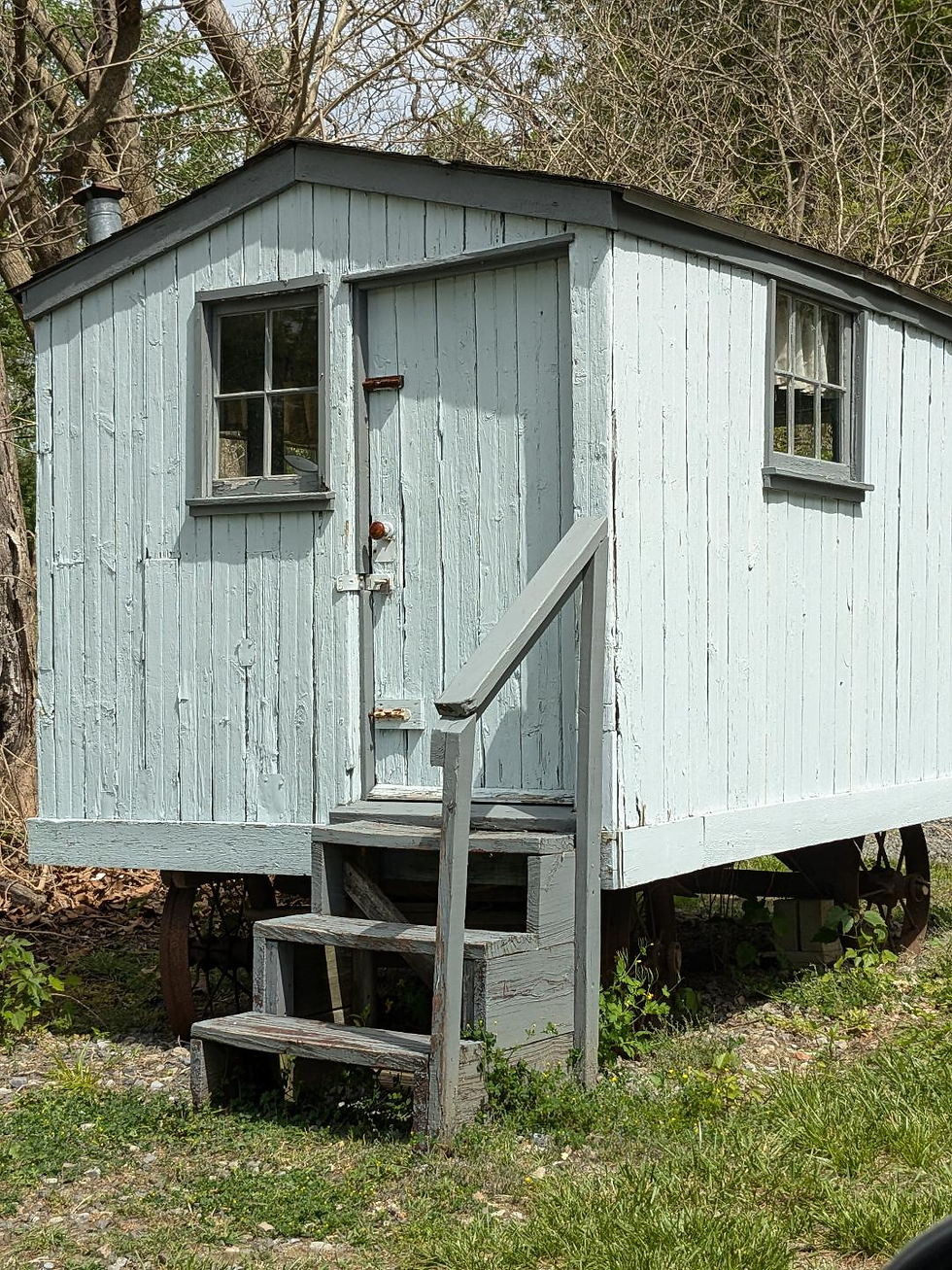
Collier's shack at Kirby's Mill...also called a Watch House. Notice the iron wheels. The house would be towed by a team of horses to wherever it was needed next. In most cases the house would remain on site for the time needed until all the wood had been reduced to a pile of charcoal. Caption courtesy of Kirby's Mill Village.
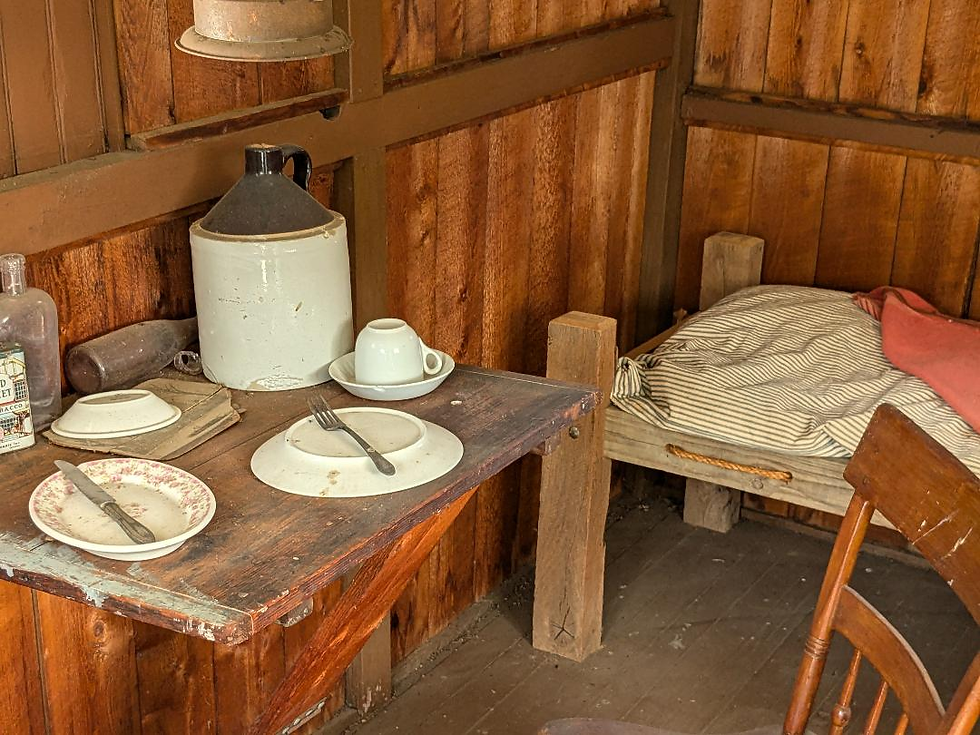
Interior of the Watch House
Charcoal making was hard work. The entire process from cutting the wood or hauling the railroad ties to bagging the charcoal, took Herbert Payne about 3 weeks. His standard 12- to 14-cord kiln with a height of 8 feet and a diameter of more than 20 feet produced an average yield of 3 tons or 350 burlap bags of charcoal. For Herbert Payne it was hard, but honest work, a good way to supplement his income. Even more, it was a labor of love that carried with it the satisfaction of knowing that he was the last of a hardy breed.
Herbert Payne of Whiting was the last active charcoal-burner in the Pines. His career as a collier began in 1934 and concluded in August 1974. In his retirement, he still set an occasional "fox" as a demonstration kiln at local folk festivals. A "fox" was a small "chunk-pit" comprised of highly flammable kindling called "brands" and "brown-backs" left over from previous burns.

Born on August 7, 1912, Herbert Payne died on March 26, 1995. With his death the tradition of 'coaling' that had stretched back to the earliest industrialization of the Pines also died. His name and memory deserve to be cherished as the last of the old-time charcoal-makers in the Pines of Southern New Jersey.

Ted would want you to notice the fine, white "sugar-sand" of the Pinelands.
Ted Gordon lived in his beloved Pine Barrens of Burlington County, New Jersey, for 60 years. I planned to visit Ted and his wife, Pat, earlier this week and learned a few days prior that Ted had passed away on May 10th. It is with a very grateful heart that I was able to meet him last year for our reunion which was the inspiration for telling this story and sharing his beautiful article with you. Nature and the Pinelands thank you for your lifetime of dedication, Ted. There will be more about Ted and his work with cranberry and blueberry cultivation at Whitesbog Village in the future.
*I feel a need to mention our dear sister, June, for without her I would not have had the pleasure of meeting Herr Gordon, and through his article, Mr. Payne.


Wow, indeed! That was fascinating.
Wow Karen. Sometimes when I start reading your blog, I think.....oh do I really want to read it but I do continue because, all of your blogs are interesting and draw me in to the story you present. Did Mr. Payne do this process single handedly? I notice his large biceps in the picture! This was incredibly hard work and I wonder, did he have to start from scratch everytime he made the kiln???!!! Quite a story...
an amazing story and photo's....VG