The Soul of a Tree
- khilton
- Jun 17
- 10 min read
Updated: 6 days ago
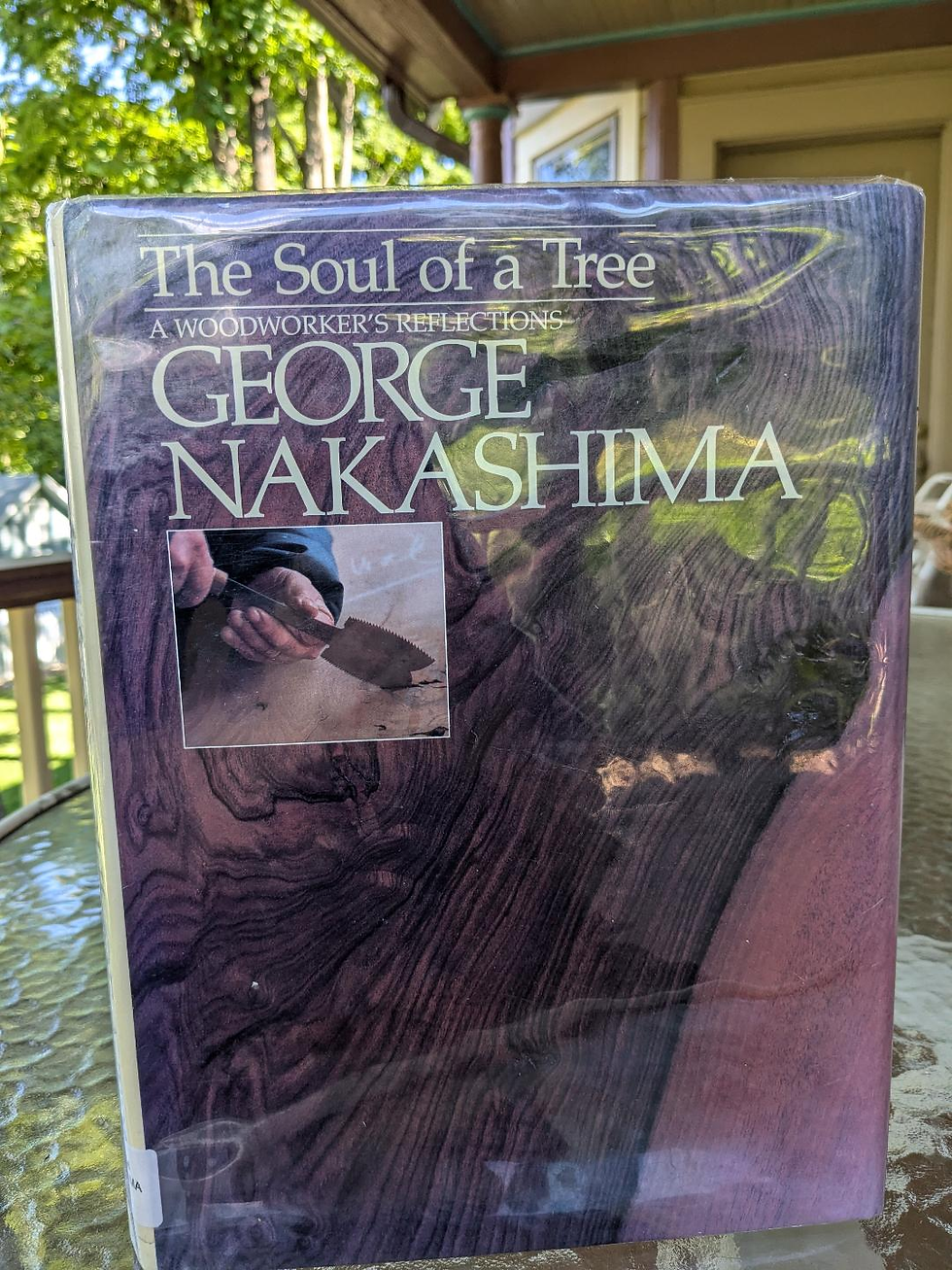
"For humankind the trees -- their roots in the ground, their heads reaching into the sky -- have seemed always to bind together the universe. But throughout the ages, humankind has looked to the trees to feed not only the flesh, but the spirit. It was beneath a tree, said to have been a fig, that Gautama Buddha had his Night of Illumination. Then he meditated for seven days under the sacred Bodhi tree, then another seven days under a great banyan, and a third seven days under the tree of the Serpent King who dwelt among its roots, before setting out on his glorious mission. It was to Jonah that God sent a tree, first to give him shade and then to teach him compassion. And closer to our own time, though perhaps still in the realm of myth we are told that Isaac Newton, driven from Cambridge into the countryside by the Plague, was inspired by the fall of an apple to formulate the law of universal gravitation. What is almost surely not a myth is that two years of enforced rustication among the fields and woods of Woolsthorpe, coming just after four years of study at Trinity College, seem to have produced in Newton a strange sense of intimacy with the universe, so that thereafter he seemed to know just what to expect of it, by intuition rather than analysis."
--George Wald, Cambridge, Mass, from foreword to "The Soul of a Tree, A Woodworkers Reflections" by George Nakashima, 1981. George Wald was a close friend of George Nakashima for many years.

Banyan Tree
That was our start to learning from George Nakashima, a life-long student who humbly allowed his intuition to develop as he kept company with trees. George might ask you to read his words for learning rather than for entertainment. What follows is his tour of timber. He teaches by the intimate way he speaks about trees and wood. Here is a sample so you might understand why he used the word "soul" in his book title. Other than the photo captions, the words are from George:
"When trees mature, it is fair and moral that they are cut for man's use, as they would soon decay and return to the earth. Trees have a yearning to live again, perhaps to provide the beauty, strength and utility to serve man, even to become an object of great artistic worth.
Each tree, every part of each tree, has only one perfect use. The long, taut grains of the true cypress, so well adapted to the making of elegant thin grilles, the joyous dance of the figuring in certain species, the richness of graining where two large branches reach out -- these can all be released and fulfilled in a worthy object for man's use.
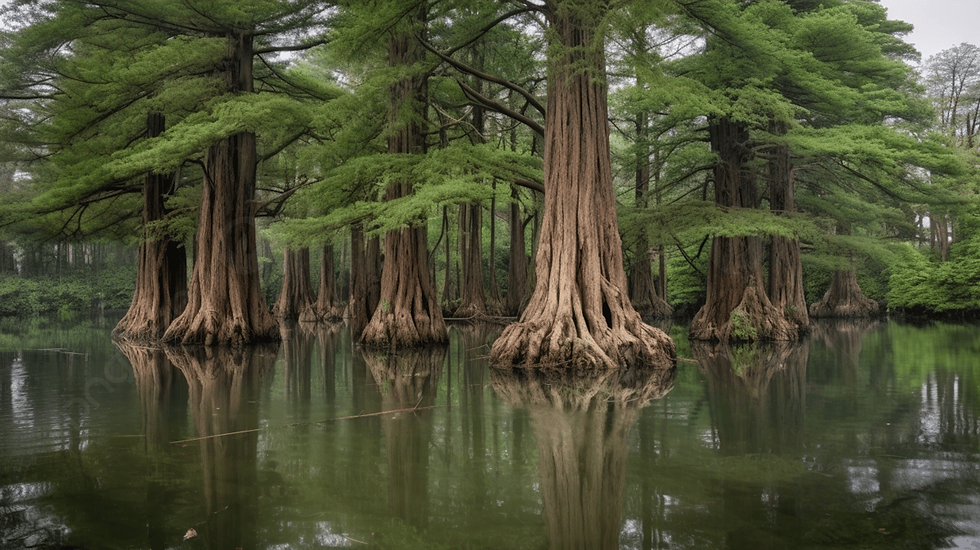
Cypress Trees
How to acquire logs and what to do with them calls for creative skill. There is so much that is wasted and unrealized. Consider the great timbers, some ten feet in diameter, piled across slopes and gulleys to make railroad beds in the early days of this country. Or the magnificent zebrawood log, from which boards fully four feet wide and eight feel long could be cut, but which instead is cut into pieces three-eighths inch thick, six inches wide! What a waste of a majestic opportunity! This is the psychology of match-stick manufacture. And the tragedy of once-in-a lifetime timbers cut into veneers so thin the light can shine through. What a waste, simply for money!
Logs from all over the world make their way to my storehouse. Some are of great value, some quite inexpensive but with interesting possibilities. There is need always to select and to search, even to look underground where the most fantastic grains can often be found.
Each species of tree has its own characteristics. Extremely long fibers and resistance to rot are characteristics of the cedar, the cypress, and, in a way, the spruces and hemlocks, the firs, and the other evergreen trees. These characteristics are important where tautness and resistance to weather are necessary. The woods from these trees often have beautiful, very straight graining and are useful in architecture for grilles like the starburst 'asa-no-ha', and even musical instruments. One of the finest perhaps is the Japanese cypress, and not far behind are the Port Orford cedar and the Alaska cedar, neither of which, incidentally, is a true cedar at all, but a cypress.

Asa-no-ha is a traditional pattern ever-present in Japanese design. It literally means 'hemp leaf" and has been used decoratively for delicate grilles on special 'shoji' sliding doors and as a sort of transom between rooms. The joinery for the asa-no-ha is perhaps the most elegant and difficult of all. At a single point, twelve members converge.
The European walnut, whether from Kashmir, the area around the Caspian Sea, southern Russia, northern Iran or eastern Turkey, or from western Europe, is among the finest of furniture woods, and one I use with frequency. American walnut, a different species, is also greatly admired.

American Walnut desk, style made famous by Nakashima featuring the Butterfly joint he popularized beginning in the 1950's, making it a signature feature of his furniture. The joint, also called the Nakashima joint is a butterfly-shaped piece of wood. Often contrasting wood like walnut was used to address wood expansion, preventing pieces from splitting apart while maintaining the natural beauty of the wood. Nakashima's approach was to enhance the wood's natural form rather than alter it and the butterfly joint became a way to strengthen and beautify his pieces. While the concept of butterfly or dovetail-type joints has historical precedents in boatbuilding and other crafts, Nakashima adapted and refined it for fine furniture, making it a hallmark of his nature-inspired, handcrafted work.
Cherry and other fruitwoods produce material of great quality. Black persimmon, often considered the finest of Japanese woods, is now extremely rare.

Black Persimmon wood.
All woods have graining -- patterns created by the trunk fibers. However, the grain of many woods, pine and maple for instance, is regular and comparatively uninteresting, while that of walnut, cherry and other fruitwoods is intricate and exciting.
Quite often the finest of grains exist underground in the root structure of many fine trees that are condemned to rot. The roots are difficult to pull out and often are deeply imbedded with stones which can be the nemesis of a sawyer. Some roots preserve their great beauty even if left underground for a hundred years, for example, those of the California redwood.

California Redwood
Burls, growths on the trunks of many trees in the shape of flattened hemispheres, are also very much esteemed. Sometimes they grow in a single clump, but at other times they may cover most of a tree. They do not seem to be particularly harmful to the health of the tree and seem to have a joy and exuberance that greatly enhances the tree's charm.

Burls on tree trunk
The sawing of logs is of prime importance. Each cut requires judgements and decisions on what the log should become. As in cutting a diamond, the judgements must be precise and exact concerning thickness and direction of cut, especially through "figures," the complicated designs resulting from the tree's grain. If a figure is cut properly, the beauty locked in the tree will gradually emerge. If cut improperly, most is lost. Gradations in color, owing to the chemical composition of the soil in which a tree grows, as well as the sharp contrast between dark heartwood and light sapwood, will add their charm.
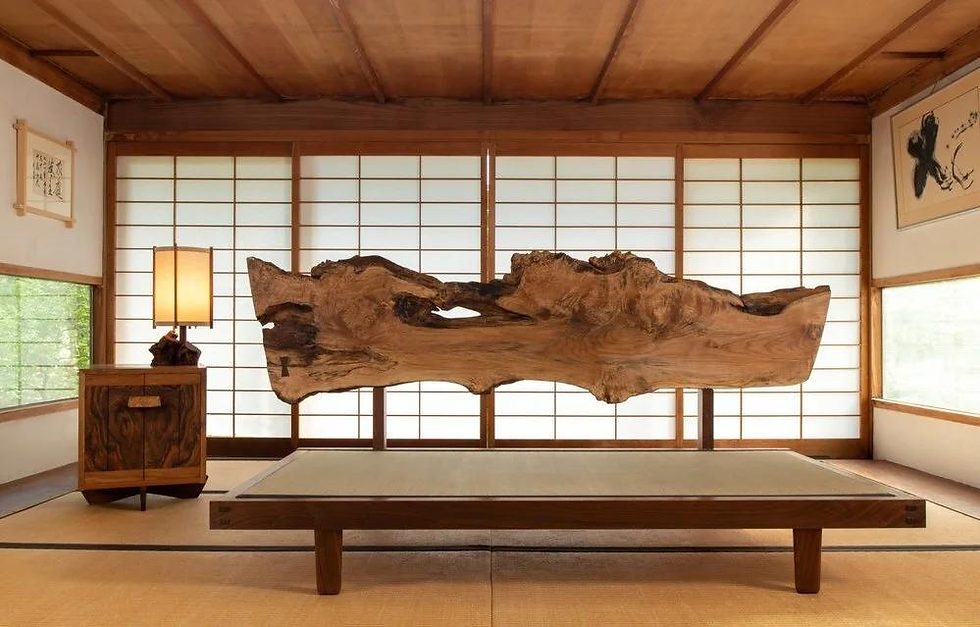
Nakashima home
There is drama in the opening of a log -- to uncover for the first time the beauty in the bole or trunk of a tree hidden for centuries, waiting to be given this second life. There are fine surprises, but also disappointments.
A great walnut, about five and a half feet in diameter, was once given to me. It seemed to have great character. A small limb pocket was filled with concrete at the top but neither a tree expert nor I imagined that the whole center had rotted out and was filled with concrete! The tree had not fallen because it was a concrete column! We were finally able, with great effort to take it down. The wood was interesting, but like many aged logs it had a tendency to be soft and weak.
I recall another instance when two logs were on the platform ready for sawing. They were English walnut. At first, there was only a suspicion that we were in the presence of a great natural wonder. The saw was a large, commercial band saw. The logs were close to six feet in diameter. They were too large! The only recourse was to hack off protrusions and excess width with a chain saw and an ax. It was devastating to see the magnificent wood handled in a such a fashion, but there was no other way. Even before the log was opened up, the experienced eye could see the incredibly lovely grain, figuring and color where a bit of bark had been knocked off. Here indeed was precious timber.
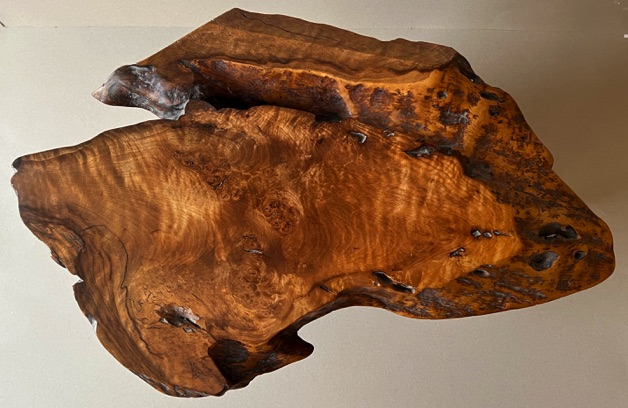
English Walnut
The revelation in the opening of the log with the first cut or two was amazing. Sensitivity, instinct and long experience came to the fore at this point. The graining and the quality of the slabs made them an English treasure. One wonders why the English timber merchants allowed these logs to leave the country. Not being able to cut the full width of the prime boards was a disappointment. I even considered calling several hand sawyers from Asia to execute the sawing.
Although we could not realize the full potential of these logs, they were of amazing quality, with a graining that would never happen again. We were able to cut boards about four feet wide and seven feet long, each board unique, each board magnificent.
The key man in the process of cutting logs is the sawyer, one of the great craftsmen of our age with steady nerves and experienced judgement. It is necessary to have an almost silent dialogue with this sawyer. Few words are spoken, but thickness, the direction of the cut, the positioning of the log -- all must be decided with precision.
During the day we saw perhaps thirty logs, some giant in size, each different from the others. Each must be analyzed to produce its full potential. As the hours pass, a silent symphony of visual tones unfolds, the beautiful expressions of nature's treasures, an occasional crescendo where the beauty touches one's heart. There is nothing like it. The workday finally ends. I am exhausted, but happy to have witnessed this unfolding spectacle."
Epilogue: Transformation
"My life has been a long search across the bumbling screes on mountain slopes around the world to find small points of glowing truth.
Backed into a soulless steel and glass jungle which threatens the disintegration of our systems and institutions we face an unknown future. With a prodigious drive we have built the first true megalopolis, but we have produced so little of any intrinsic value. There is not a single monument in recent centuries to express any sort of transcending human will or soul. Taken as a whole we have the poorest assemblage of architecture in the history of man, without a single building of greatness.
There are few to listen or to see, but a small nucleus of truth resides in the crannies of the world waiting for a receptive ear. The Karma Yogin, he who follows the path of action, understands the road that must be taken. We are on the verge of a great and heroic revolution, a revolution of the soul -- a revolution so vast and influential that the revolutions of the West, the French, the American and the Russian, will appear childish and impotent. The transformations stretch out into endless vistas before us.
The transformation calls for the joining together of those who seek "something else," who aspire to new lives free from material desire, who can throw open their arms in charity and create purer forms than we have ever known.
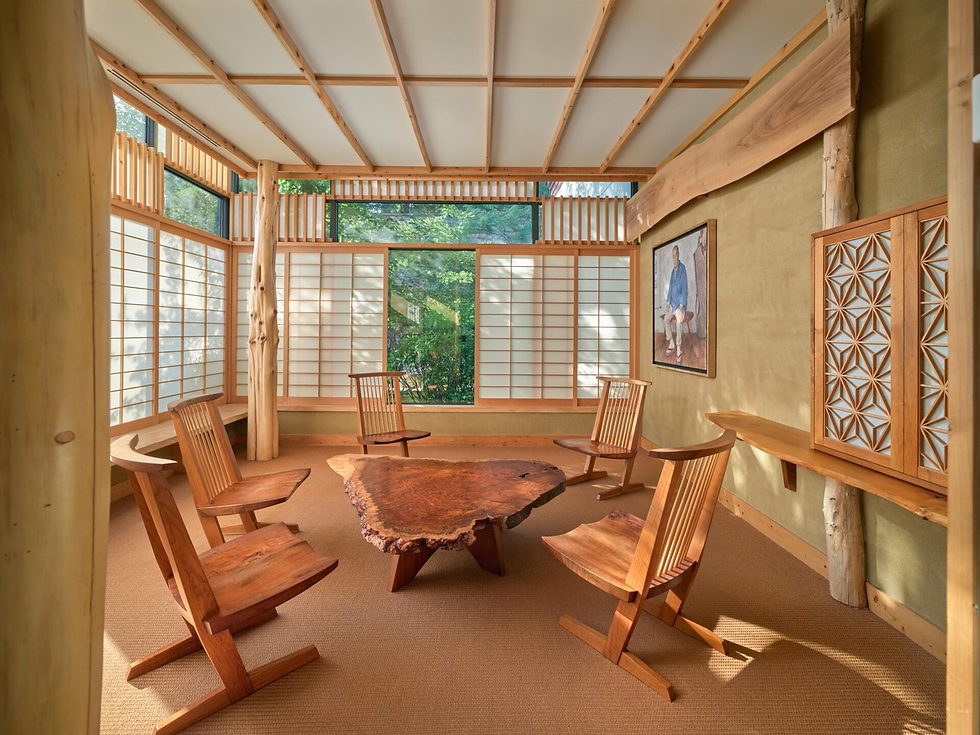
In 1992, one year after George Nakashima's passing, the Michener Art Museum, Doylestown, PA, commissioned his daughter, Mira Nakashima (b. 1942), architect and furniture maker, to design a Memorial Reading Room in honor of her father. The Nakashima Reading Room features his furniture designs within a Japanese tearoom setting, offering space for rest and quiet reflection to the museum visitor.
With so many people of good will searching for bits of light, a great movement will one day arrive based on the union of total freedom with a creativity that we cannot see or even conceive of.
It is a difficult movement, a pioneering movement, similar in a way to that experienced by the early English settlers. The movement involves not only beating back the wilderness but also beating back the soulless urban jungles throughout the world.
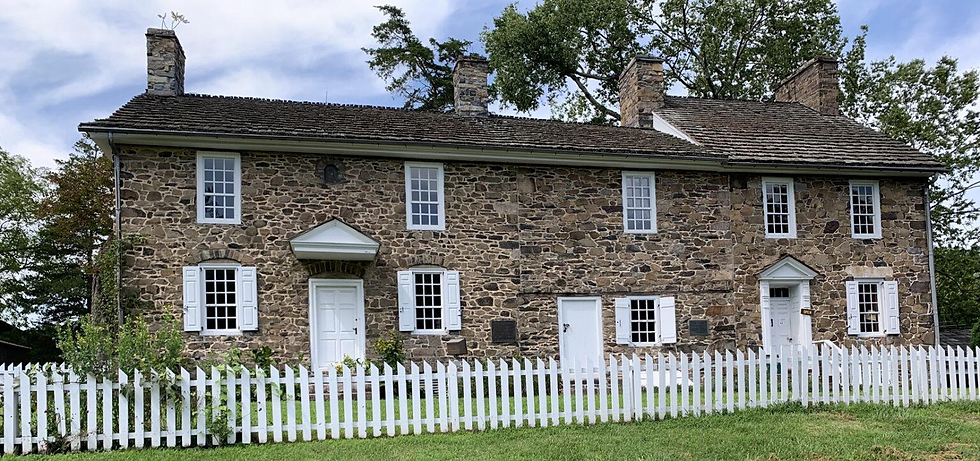
front of the Thompson-Neely House, New Hope, PA
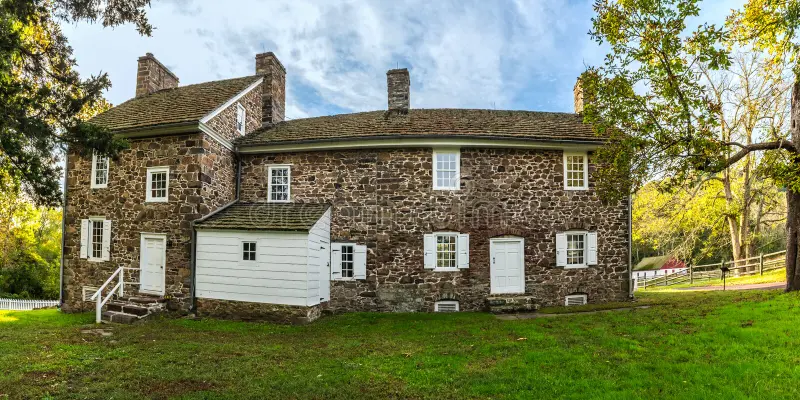
back view of Thompson-Neely House
Thompson-Neely House, dating to the Revolutionary period, stands about a mile down the road from the workshop. Seemingly built to last forever, houses like these had walls of local fieldstone from twenty inches to two feet thick. They were heated by great "walk-in" fireplaces. Whole logs were dragged in by horse; this is why the design calls for doors on opposite sides of the room--so the horse could be led through and out the door.
It is sad that when some movements arrive their time is already past. Such is the case with "modern" art. "Modern" architecture was interesting and exciting in the thirties but by the eighties structures have become filled with dead forms. The new buildings do not have the staying power and catholicity of architecture during the truly great periods.
The deep, rich movements, which produced the Dipylon vase, the Doric column, the Chartres cathedral, the Katsura Detached Palace, all were significant in their youthful vigor and simple creativity. May we return to that spirit. It is not man's prerogative to destroy himself. We can only believe in the warm golden light in the darkness.
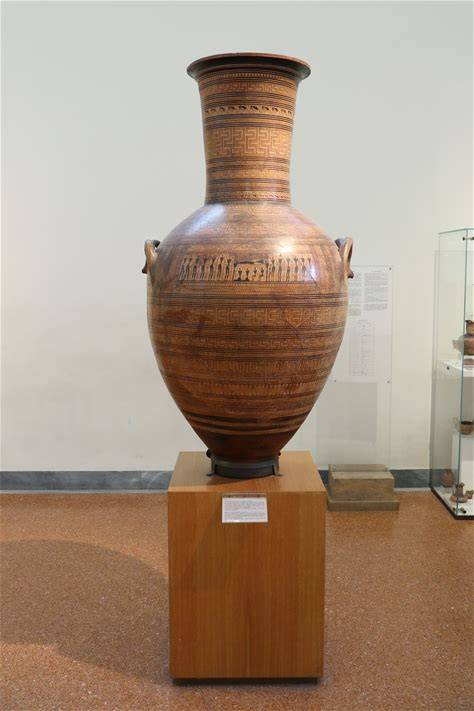
also called the Diplyon Amphora, 760-750 B.C., Greece.
Since I am a woodworker, the practical aspects interest me primarily. The materials used, the utility of an object, the forms developed are vital. The necessary skills and the resultant beauty must be there. Arts and crafts should be based on pure truth, taking materials and techniques from the past to synthesize with the present. We should be content to work on a small scale and integrally with nature and not violate it.
In a personal way my family and I have gone underground, since we have little relationship to contemporary mores, institutions, economy or systems. Ours is a search for pure truth in the most realistic of ways -- the making of things.
There was no other way for me but to go alone, secure with my family, placing stone upon stone, seeking kinship with each piece of wood, eventually creating an inward mood of space, then bit by bit finding peace and joy in shaping timber into objects of utility and perhaps, when nature smiles, beauty."

George Katsutoshi Nakashima, 1905-1991. The workshop offers tours by reservation only. Reservations are available for 2027. https://nakashimawoodworkers.com/visit/
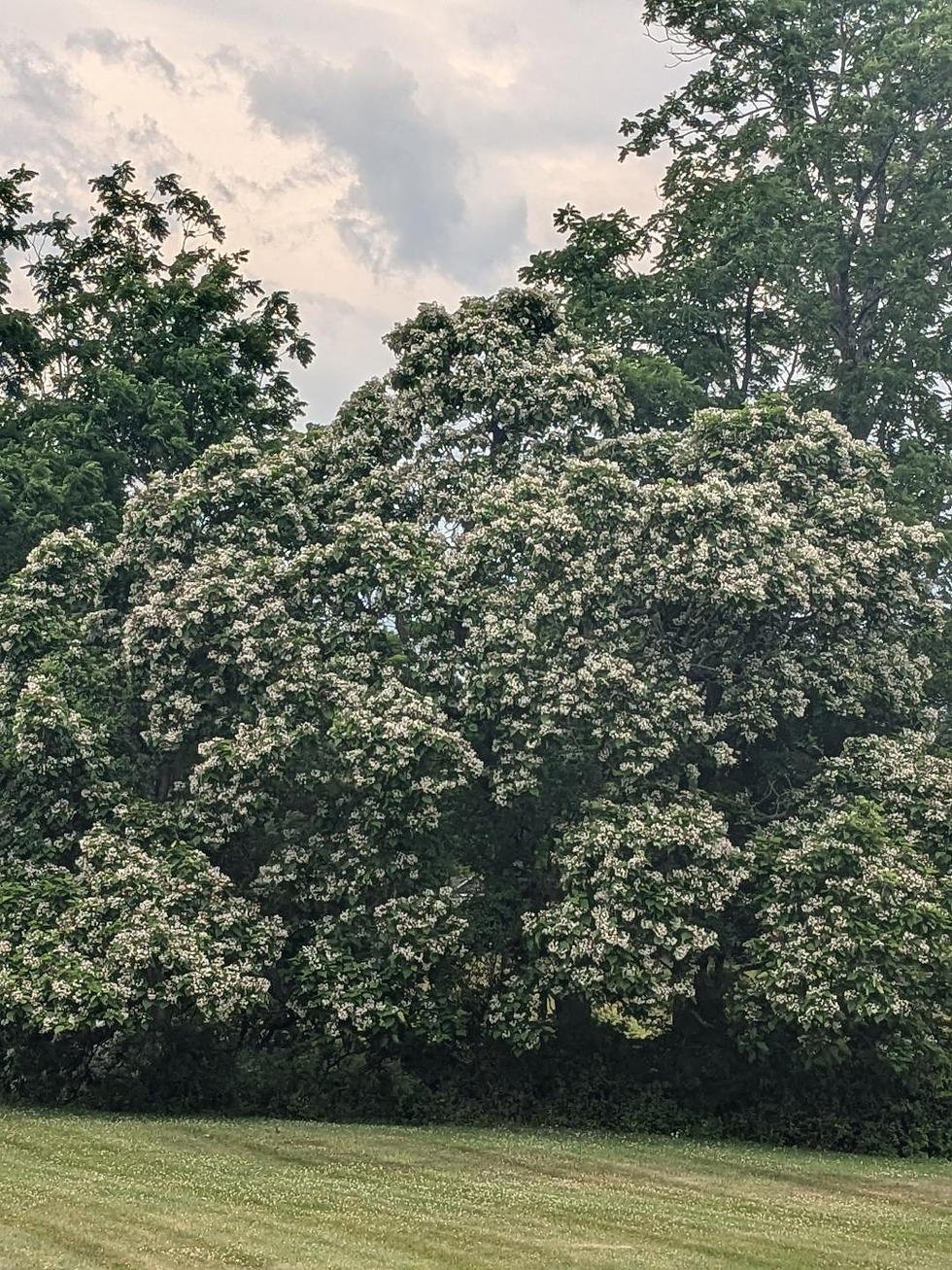

Transformation, from your writing, a single word that stands out like a Redwood for me. Trees transfer energy and life to this earth transforming at Mother Nature's Divine will all life. Trees keep our rivers company offering life to beasts and butterflies, fauna and flora, and to the humans that have the good fortune of just simply being in their presence. The Tree of Life. I say no more.
PS. I love them all but that Pine Tree holds sacred energy for me and memory. That Christmas tree we picked out at a tree farm, returned in the new year as children that my father dragged into the house to offer a place for our Nativity and our Baby J…
Karen, This was a very interesting and intriguing story about trees, wood, etc. Who knew so much went into this craft....I noticed Mr Nakashima is japanese. It made me think of the wooden temples in Japan where they don't use any nails to build and the structures last for 100's and 1000's of years. I was always so curious how wood could last that long, so asked AI. Now I know. Very interesting addendum to your story. Leave it to the japanese. Masters of the Art.